Free tools • Instant results • No signup

Is Your Salary Keeping Up With Inflation? Here's How to Check
Find out if your salary is really keeping up with inflation. Learn how to calculate your real wage, what the numbers mean, and exactly what to do about it.
INCOME & CAREER
Rachel
5/5/20266 min read
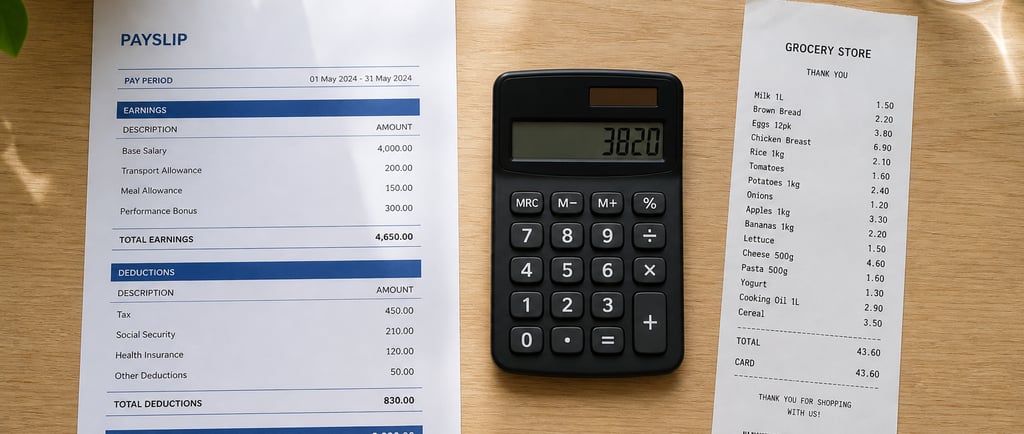
You got a pay rise last year. Maybe even the year before. But somehow it still feels like money is tighter than it used to be. Your grocery shop costs more. Your rent went up. Petrol, electricity, insurance — all higher than they were two or three years ago.
You are not imagining it. And it is probably not your spending habits.
There is a very good chance your salary is not keeping up with inflation — and this post will show you exactly how to check, what the numbers mean, and what to do about it.
Why Your Salary Might Be Falling Behind Without You Realising
Most people think about their salary in one way — the number on their payslip. If that number goes up, they feel like they are doing better. If it stays the same, they feel like they are standing still.
But that is not how money actually works.
The real question is not whether your salary went up. The question is whether it went up by more than inflation. Because if inflation grew faster than your salary — even if you received a pay rise — your purchasing power actually decreased.
This is called a real wage decline. And it has been happening to millions of workers across Australia, the US, the UK, and most of the developed world, particularly since 2021 when inflation surged to multi-decade highs.
The tricky part is that it is invisible. Your payslip shows a bigger number than it did two years ago. But what that number can actually buy has quietly shrunk.
How to Check If Your Salary Is Keeping Up With Inflation
Here is the simple three step process:
Step 1 — Find the inflation rate for your country
You need the cumulative inflation figure for however many years you want to look back — not just the most recent annual rate.
Australia: Australian Bureau of Statistics (ABS) — abs.gov.au
United States: Bureau of Labor Statistics (BLS) — bls.gov
United Kingdom: Office for National Statistics (ONS) — ons.gov.uk
For a quick working figure, Australian inflation averaged roughly 4–5% per year between 2021 and 2024. The US saw similar patterns, peaking at 9.1% in mid-2022 before falling back.
Step 2 — Calculate what your salary should be
Take your salary from a specific point in the past and multiply it by the cumulative inflation factor.
For example: if you earned $60,000 in 2021 and cumulative inflation since then has been around 18%, your salary today would need to be at least $70,800 just to have the same purchasing power.
Formula:
Required salary = Past salary × (1 + cumulative inflation rate)
Step 3 — Compare to your actual salary
If your actual current salary is above that number — you are ahead of inflation. If it is below — you have quietly taken a real pay cut, regardless of any nominal raises you received along the way.
Use our Pay Rise Calculator to run these numbers instantly for any given year and inflation rate.
Real Example — What Three Years of Below-Inflation Raises Looks Like
Meet Sophie. In 2021 she earned $72,000 as a marketing manager. Over three years she received annual raises of 2%, 2.5%, and 2%.
Here is what happened to her salary in real terms:
Sophie's payslip showed nearly $5,000 more than it did in 2021. But her real purchasing power dropped by nearly $8,000. She took a significant pay cut while being told she was being rewarded every single year.
What Counts as Keeping Up With Inflation?
Here is a simple breakdown:
Why Does This Keep Happening?
There are a few reasons why so many workers end up with salaries that trail inflation:
Employers anchor to round numbers Many companies have informal policies of offering 2–3% annual raises regardless of what inflation is actually doing. In low-inflation years this was fine. In high-inflation years it quietly devastated workers' real incomes.
Workers don't negotiate enough Studies consistently show that people who ask for more get more. But most workers accept the first offer, especially if it comes with language like "this is our standard increase" or "budget is tight this year."
Inflation happens gradually The erosion is slow enough that most people don't notice it in any given year. It is only when you look back over three or four years that the gap becomes obvious.
Cost of living varies by location National inflation figures are averages. If you live in a major city where housing costs have risen faster than the national CPI, your personal inflation rate is likely higher than the headline number.
What To Do If Your Salary Is Falling Behind
1. Calculate your gap first Use our Pay Rise Calculator to find out exactly how much your salary needs to increase just to break even with inflation — and how much more to actually get ahead. Walk into any salary conversation with this number ready.
2. Build your case with data Salary negotiation works best when you have specifics. Document your achievements from the past year. Find market salary data for your role on Seek, LinkedIn, or Glassdoor. Show your employer what someone in your role earns elsewhere.
3. Ask for more than you need If you need a 5% raise to break even, ask for 8%. Negotiations almost always land somewhere in the middle. Starting at your floor means you will end up below it.
4. Explore total compensation If your employer genuinely cannot move on base salary, negotiate other things with real dollar value — additional super contributions, extra leave, flexible working, a professional development budget, or a performance bonus structure.
5. Consider the market Sometimes the most effective salary negotiation is a job offer from a competitor. Even if you don't want to leave, a genuine competing offer gives you real leverage. Many people receive their biggest salary jump by changing employers rather than waiting for internal raises.
6. Set a review date If your employer can't give you what you need right now, ask for a formal review in six months with clear milestones attached. Get it in writing. A promise without a date and criteria is just a way of putting you off indefinitely.
How to Stay on Top of It Every Year
Make this a yearly habit, not a one-off check:
Every January look up your country's latest annual CPI figure
Run your current salary through the Pay Rise Calculator
Compare your position to where you were 12 months ago
Prepare your case for your annual review with fresh data
The people who build strong financial lives are not necessarily the highest earners. They are the ones who pay attention — and act on what they see.
Frequently Asked Questions
Q: What if my employer says there is no budget? Ask when there will be budget. Ask what you would need to achieve to unlock a higher increase. Ask about non-salary benefits. And quietly start looking at the market. "No budget" is sometimes true and sometimes negotiating language.
Q: Should I bring up inflation in a salary negotiation? Yes — but frame it constructively. Rather than saying "inflation means I need more money," say "I want to make sure my compensation reflects both my contribution and the current cost of living environment." It is the same point, made in a way that focuses on your value.
Q: What if I am self-employed or freelance? The same principle applies to your rates. If your day rate or project fees have not increased in line with inflation, your real income is falling. Review your rates at least annually and adjust accordingly.
Q: Is it rude to ask for a raise based on inflation? Not at all. Asking for your real compensation to keep pace with the cost of living is entirely reasonable and professional. Most employers expect it. What surprises them is when good people don't ask.
Check Your Numbers Right Now
Stop guessing and run the actual numbers. Our free Pay Rise Calculator lets you enter your current salary, your most recent raise, and the current inflation rate — and tells you instantly whether you are ahead, even, or falling behind.
👉 Use the Pay Rise Calculator here
And if you want to understand inflation more deeply before your next negotiation, start with our guide: What Is Inflation and Why Should You Actually Care?
Share this with someone who got a pay rise recently and thinks they are doing great. The numbers might tell a different story.
Related Useful Links:
See How Inflation Is Affecting Your Money
A pay rise doesn't always mean you're better off. If prices are rising faster than your income, your purchasing power may actually be falling.
Use our free Inflation Calculator to see how the value of money changes over time and put inflation into perspective.
Try the Inflation Calculator →
Want to see how your current income fits with your everyday expenses?
ClearEveryday
Free financial calculators and practical money tools for everyday decisions.
Plan your budget, manage debt, build savings, explore investing and understand your money — with simple tools and no sign-up required.
Link
© ClearEveryday 2026. All rights reserved.
About
“For informational purposes only — not financial advice.”