Free tools • Instant results • No signup

See how compound interest could help your money grow over time. Enter your starting amount, regular contributions, interest rate, and timeframe to estimate your future balance and total interest earned.
Compound Interest Calculator
How to Use This Compound Interest Calculator
This calculator helps you estimate how your money could grow over time through compound interest and regular contributions. Adjust the figures to compare different savings scenarios and see how changes to your contributions, interest rate, or timeframe may affect the result.
Step-by-step:
Enter your starting amount
Add the amount of money you already have available at the beginning of the calculation. If you are starting from zero, simply enter $0.Add your monthly contribution
Enter how much you plan to contribute each month. You can also enter $0 if you only want to calculate the growth of your starting balance.Enter the annual interest rate (%)
Add the annual interest rate you want to use for your estimate. This could be a savings account rate or another hypothetical rate you want to test.Choose your timeframe
Select how many years you want your money to grow. Try different timeframes to see how additional years can affect compound growth.Select the compound frequency
Choose how often interest is compounded — daily, monthly, quarterly, semi-annually, or annually. The effect of compounding frequency will depend on the interest rate and other assumptions used.Review your estimated results
The calculator automatically displays your:Estimated future balance
Total contributions
Interest earned
Growth multiple
Estimated end date
💡 Tip
Try changing one input at a time to see how it affects your result. Increasing your monthly contribution, extending your timeframe, or testing different interest rates can help you compare different scenarios.
Disclaimer
This calculator provides estimates for general informational purposes only. Actual results may vary due to interest rate changes, contribution timing, fees, taxes, account conditions, investment performance, and other factors.
What Is a Compound Interest Calculator?
A compound interest calculator helps you estimate how money could grow over time when interest is added to both your original balance and the interest already earned.
Unlike simple interest, which is calculated only on the starting amount, compound interest is calculated on an increasing balance. As interest is added over time, future interest may be calculated on a larger amount.
By entering your starting amount, regular contributions, interest rate, compounding frequency, and timeframe, the calculator can estimate your future balance, total contributions, and interest earned.
You can use a compound interest calculator to explore different savings scenarios, compare contribution amounts, test different interest rates, or see how a longer timeframe may affect your results.
Understanding how compound interest works can help you make more informed decisions about saving and planning for longer-term financial goals.
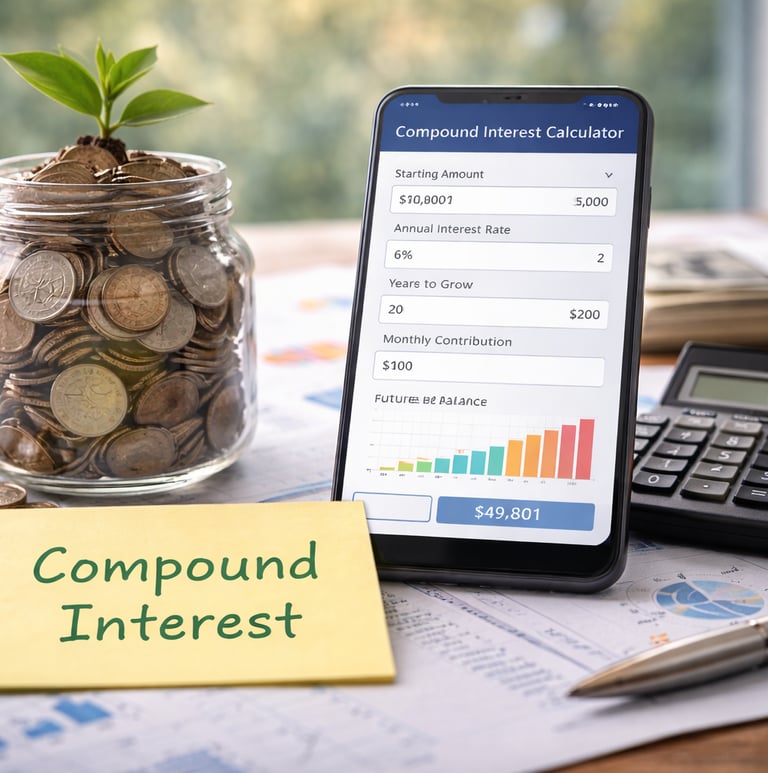
Here’s a simple example of how regular contributions and compound interest could affect a balance over 20 years.
Example assumptions:
Starting amount: $10,000
Monthly contribution: $500
Annual interest rate: 7%
Timeframe: 20 years
Compounding: Monthly
Estimated Results
Total contributions: approximately $130,000
Interest earned: approximately $171,000
Estimated future balance: approximately $301,000
What This Example Shows
Over 20 years, you would contribute a total of $130,000, including the original $10,000 starting amount and $500 monthly contributions.
With a constant 7% annual interest rate compounded monthly, the example balance could grow to approximately $301,000. Around $171,000 of that amount would come from compound interest rather than your contributions.
This illustrates why time, regular contributions, and compounding can have a substantial effect on long-term growth.
Key Takeaways
A longer timeframe gives compound interest more time to accumulate.
Regular contributions can have a major effect on your ending balance.
Interest earned can begin earning additional interest over time.
Changing the interest rate, contribution amount, or timeframe can significantly change the result.
Important: This is an illustrative example that assumes a constant 7% annual interest rate. Actual results may be higher or lower, and interest rates or investment returns are not guaranteed.
Example: How Compound Interest Can Grow Over Time
Low vs High Contribution Comparison
What This Shows
Increasing the monthly contribution from $200 to $500 could result in a significantly larger estimated balance over 20 years.
Higher contributions mean more money is being added, while also giving those additional contributions more time to potentially earn compound interest.
Over longer timeframes, regular contributions and compounding can work together to substantially increase the estimated ending balance.
💡 Key Takeaway
Even a modest increase in your monthly contribution can make a meaningful difference over time. How much you contribute, how long you save, and the rate of return can all have a significant effect on your final balance.
Remember: The results are estimates. Actual growth will depend on the interest rate or return achieved, contribution timing, fees, taxes, and other factors.
Let’s compare how different monthly contributions could affect your estimated balance over time.
Scenario:
Starting amount: $10,000
Annual interest rate: 7%
Timeframe: 20 years
Compounding: Monthly

1. What is compound interest?
Compound interest is interest calculated on both your starting balance and the interest that has already accumulated. Over time, this means your interest can also begin earning interest.
2. How does a compound interest calculator work?
A compound interest calculator uses your starting amount, regular contributions, interest rate, timeframe, and compounding frequency to estimate your future balance and total interest earned.
3. How often can interest be compounded?
Interest may be compounded daily, monthly, quarterly, semi-annually, or annually. The frequency depends on the account or financial product. More frequent compounding can produce a different result when other assumptions remain the same.
4. What is the difference between simple interest and compound interest?
Simple interest is calculated only on the original amount. Compound interest is calculated on the original amount plus previously accumulated interest, allowing the balance to compound over time.
5. How much will $10,000 grow with compound interest?
It depends on the interest rate, timeframe, compounding frequency, and whether you make additional contributions. For example, $10,000 will produce very different results over 5 years compared with 20 years. Use the calculator above to test your own assumptions.
6. Do monthly contributions make a difference to compound growth?
Yes. Regular contributions increase the amount of money in the account, giving additional funds an opportunity to earn interest over time. The amount and timing of contributions can significantly affect the estimated final balance.
7. What interest rate should I use in the compound interest calculator?
Use a rate appropriate for the scenario you want to estimate. For a savings account, you could use its current annual interest rate. For other scenarios, use a reasonable hypothetical rate and compare several rates rather than assuming one rate will remain constant.
8. Are compound interest calculator results guaranteed?
No. The results are estimates based on the information and assumptions you enter. Actual results may differ because of changing interest rates or returns, fees, taxes, contribution timing, withdrawals, and other factors.
Frequently Asked Questions
A compound interest calculator can help you explore how money could grow over time based on different assumptions. By adjusting your starting amount, regular contributions, interest rate, compounding frequency, and timeframe, you can compare different scenarios and see how each factor affects the estimated result.
For a broader view of your finances, you may also find these tools helpful:
Savings Goal Calculator – estimate how much you may need to save regularly to reach a specific target.
Savings Calculator – estimate how your savings could grow with regular contributions and interest.
Debt Payoff Calculator – estimate how long it could take to repay debt based on your balance, interest rate, and payments.
Budget Calculator – see how your income and expenses are distributed and identify how much you may have available to save.
Use these calculators together to explore different scenarios, set realistic financial goals, and make more informed decisions about your money.
Explore More Financial Calculators
Smart Financial Calculators
Tools designed to help you make clear financial decisions daily.
Personal Loans
Estimate repayments, interest, and total costs before you borrow.
Track your balance, reduce interest, and pay off your debt faster.
Credit Cards




Car Loans
Calculate your monthly car payments and plan your budget with confidence.


ClearEveryday
Free financial calculators and practical money tools for everyday decisions.
Plan your budget, manage debt, build savings, explore investing and understand your money — with simple tools and no sign-up required.
Link
© ClearEveryday 2026. All rights reserved.
About
“For informational purposes only — not financial advice.”