Free tools • Instant results • No signup

How Much Should I Have in an Emergency Fund in 2026?
Not sure how much to save in your emergency fund? This simple guide shows you exactly how much you need in 2026 — plus a free calculator to find your number.
SAVINGS & BUDGETING
Rachel
4/7/20265 min read
If you've ever had a car break down, lost a job unexpectedly, or faced a surprise medical bill, you already know why an emergency fund matters. It's the financial cushion that stops a bad week from turning into a debt spiral.
But how much is actually enough? With the cost of living higher than ever in 2026, the old rules might not cut it anymore.
This guide breaks it all down — simply, clearly, and with an Australian lens.
What Is an Emergency Fund?
An emergency fund is money set aside specifically for unexpected expenses. Not a holiday. Not a new phone. Not a planned car service. It's for the genuine surprises — the ones that would otherwise force you to reach for a credit card or a loan.
Think of it as your financial insurance policy. You hope you never need it. But when you do, you'll be very glad it's there.
Common emergencies it covers:
Sudden job loss or reduced hours
Medical or dental expenses not covered by Medicare or private health
Urgent car or home repairs
A family emergency requiring travel
Unexpected vet bills
The Standard Rule: 3 to 6 Months of Expenses
The most widely recommended guideline is to save enough to cover 3 to 6 months of essential living expenses.
This isn't 3 to 6 months of your full income — it's 3 to 6 months of what you actually need to survive: rent or mortgage, groceries, utilities, transport, insurance, and minimum debt repayments.
So if your essential monthly expenses are $3,500, your emergency fund target would be:
3 months: $10,500 (minimum target)
6 months: $21,000 (comfortable target)
Should You Save More in 2026?
In recent years, many financial experts have updated their advice. With cost of living pressures, rising interest rates affecting mortgage holders, and a tighter job market in some industries, the traditional 3-month minimum may no longer be enough for everyone.
Here's a simple way to think about it:
Closer to 3 months if you:
Have a stable, secure job (government, essential services, long-term employer)
Have a dual income household
Have no dependants
Have other accessible assets you could tap in a real emergency
Closer to 6 months (or more) if you:
Are self-employed or work casual/contract hours
Have a single income household
Have dependants (kids, elderly parents)
Work in a volatile industry
Have a mortgage rather than renting
Have health conditions that could affect your ability to work
If you're self-employed, some advisors now recommend up to 12 months of expenses — because both your income and your business expenses can be unpredictable at the same time.
How to Calculate Your Personal Emergency Fund Target
The fastest way to find your number is to use our free Emergency Fund Calculator. Enter your monthly expenses and it will tell you exactly how much to aim for based on your situation.
If you want to work it out manually, here's how:
Step 1: Add up your essential monthly expenses:
Rent or mortgage repayment: $____
Groceries: $____
Utilities (electricity, gas, water, internet): $____
Transport (fuel, registration, public transport): $____
Insurance (health, car, home): $____
Minimum debt repayments: $____
Childcare or school fees (if applicable): $____
Step 2: Add them all up to get your monthly essential expenses total.
Step 3: Multiply by 3 for your minimum target, or by 6 for a comfortable target.
Example:
Rent: $1,800
Groceries: $600
Utilities: $300
Transport: $400
Insurance: $200
Debt repayments: $200
Total: $3,500/month
3-month target: $10,500
6-month target: $21,000
Notice what's NOT on this list: dining out, subscriptions, entertainment, clothing, holidays. Your emergency fund covers survival, not lifestyle. That's what keeps the number manageable.
Where Should You Keep Your Emergency Fund?
Your emergency fund needs to be:
Accessible — you need to be able to get to it quickly when something goes wrong
Separate — not mixed with your everyday spending account (or you'll spend it)
Low risk — this is not money to invest in shares or crypto
The best home for an emergency fund in Australia right now is a high-interest savings account. With interest rates higher than they've been in years, you can earn a reasonable return while keeping your money safe and accessible.
Look for accounts with:
No monthly fees
No minimum deposit requirements
Easy online access
A competitive ongoing interest rate (not just a honeymoon rate)
Avoid putting your emergency fund in term deposits — they lock your money away for a fixed period, which defeats the purpose.
How Long Will It Take to Build?
Building a 3 to 6 month emergency fund can feel overwhelming, especially if you're starting from zero. The key is to treat it like a bill — a non-negotiable monthly transfer that happens automatically before you have a chance to spend the money.
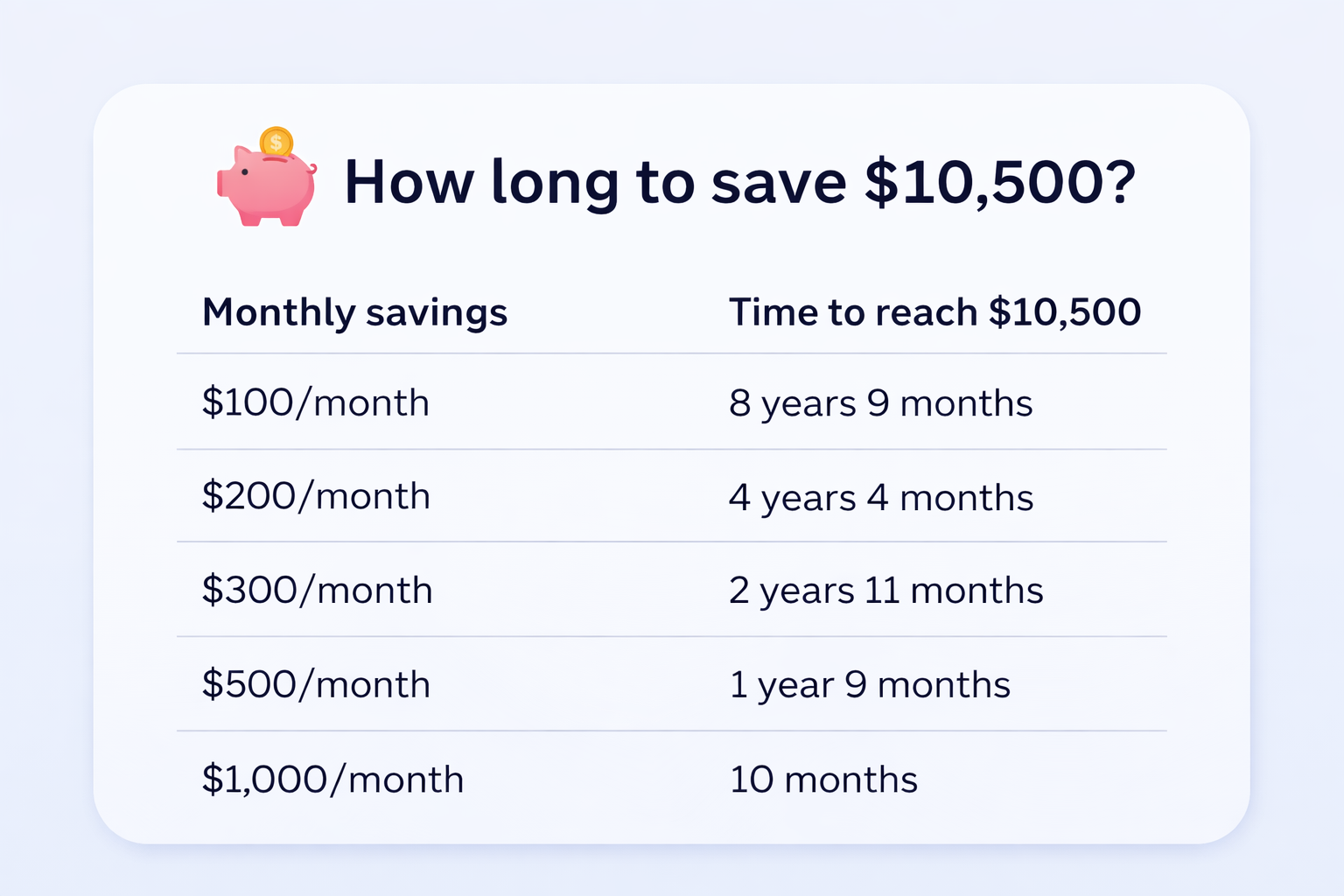
Here's how long it takes to reach $10,500 depending on how much you save per month:
Even $200 a month gets you there in under 5 years — and many people find they can save much faster once they make it a priority and cut back in a few areas.
Use our Savings Goal Calculator to set a target date and work backwards to find exactly how much you need to save each month to hit it.
Tips to Build Your Emergency Fund Faster
1. Start with a mini goal Don't think about $10,000 right away — aim for $1,000 first. That small buffer already protects you from the most common emergencies (car repairs, unexpected bills). Once you hit $1,000, set the next target.
2. Automate it Set up an automatic transfer to your savings account on payday. Even $50 a fortnight adds up to $1,300 a year without you thinking about it.
3. Use windfalls wisely Tax refunds, bonuses, birthday money — instead of spending the whole thing, put at least half into your emergency fund. A single $1,500 tax refund can wipe months off your timeline.
4. Do a spending audit Use our Budget Calculator to see exactly where your money goes each month. Most people find at least one or two expenses they can reduce or cut entirely — and redirecting even $100/month makes a real difference over time.
5. Sell things you no longer need A quick clear-out of clothes, furniture, electronics, or sports equipment you haven't used in a year can put $300–$1,000 straight into your emergency fund with zero ongoing effort.
What Counts as a Real Emergency?
Once your fund is built, the hardest part is not spending it. It's tempting to dip into it for things that feel urgent but aren't genuine emergencies.
Is an emergency:
Job loss
Medical bill not covered by insurance
Urgent car repair needed to get to work
Emergency home repair (burst pipe, broken heater in winter)
A family crisis requiring immediate travel
Is NOT an emergency:
A sale on something you want
A holiday
A planned car service or registration (budget for these separately)
Christmas or birthday presents
A new phone because your current one is old
I
f you find yourself dipping into the fund for non-emergencies, consider moving it to a separate bank entirely — one that requires a day or two to transfer. A small amount of friction goes a long way.
What If You Have Debt AND No Emergency Fund?
This is one of the most common dilemmas in personal finance. Should you pay off debt first, or build an emergency fund first?
The answer: do both, but start with a small buffer.
Before aggressively paying off debt, aim for a $1,000–$2,000 starter emergency fund. This protects you from having to go further into debt if something goes wrong while you're in payoff mode. Once you have that small buffer, focus on eliminating high-interest debt (especially credit cards), then come back and build the full emergency fund.
Check out our Credit Card Payoff Calculator and Debt Payoff Calculator to build a plan that handles both at once.
The Bottom Line
In 2026, the recommended emergency fund is still 3 to 6 months of essential expenses — but where you land in that range depends on your job security, income type, family situation, and overall financial picture.
The most important thing is to start. Even $500 in a separate savings account is infinitely better than nothing. Every month you add to it, you're buying yourself a little more security and a little less financial stress.
Use our free Emergency Fund Calculator to find your exact target, then set up an automatic transfer today.
ClearEveryday provides free financial calculators to help everyday Australians understand their money. Our tools are for informational purposes only and do not constitute financial advice. Always consider speaking with a qualified financial professional for personalised guidance.
ClearEveryday
Free financial calculators and practical money tools for everyday decisions.
Plan your budget, manage debt, build savings, explore investing and understand your money — with simple tools and no sign-up required.
Link
© ClearEveryday 2026. All rights reserved.
About
“For informational purposes only — not financial advice.”