Free tools • Instant results • No signup

How Much Do I Need to Retire? (And How to Calculate It)
Wondering how much you need to retire comfortably in Australia? This simple guide breaks down the numbers, the rules of thumb, and how to calculate your exact retirement target.
SAVINGS & BUDGETING
Rachel
4/7/20266 min read
"How much do I need to retire?" is one of the most Googled financial questions in the world — and for good reason. It's one of the biggest financial decisions you'll ever make, and the answer is different for everyone.
The frustrating truth? Most people either have no idea what their number is, or they're working from a figure they heard somewhere years ago that may no longer apply.
In 2026, with superannuation rules evolving, cost of living higher than ever, and Australians living longer than previous generations, getting this number right matters more than ever.
This guide cuts through the noise and gives you a clear, practical framework for calculating exactly how much you need to retire — and how to get there.
Why Most People Get This Wrong
The most common mistake people make when thinking about retirement savings is focusing on a single big number — "I need $1 million" — without understanding where that number comes from or whether it actually applies to their situation.
The truth is, how much you need to retire depends on:
What age you want to retire
How long you expect to live in retirement
What kind of lifestyle you want
Whether you own your home outright
What other income sources you'll have (super, Age Pension, investment income)
Where in Australia (or the world) you plan to live
A single person who owns their home in regional Queensland and wants a simple retirement needs a very different number than a couple who wants to travel internationally and live in Sydney.
Let's break it down properly.
Step 1: Figure Out How Much You'll Spend in Retirement
The most reliable way to estimate your retirement number is to start with what you'll actually spend — not your current income.
Most financial planners suggest that retirees typically spend 60–80% of their pre-retirement income, because by then you've usually:
Paid off your mortgage
Finished raising children
Eliminated commuting and work-related costs
Paid off most major debts
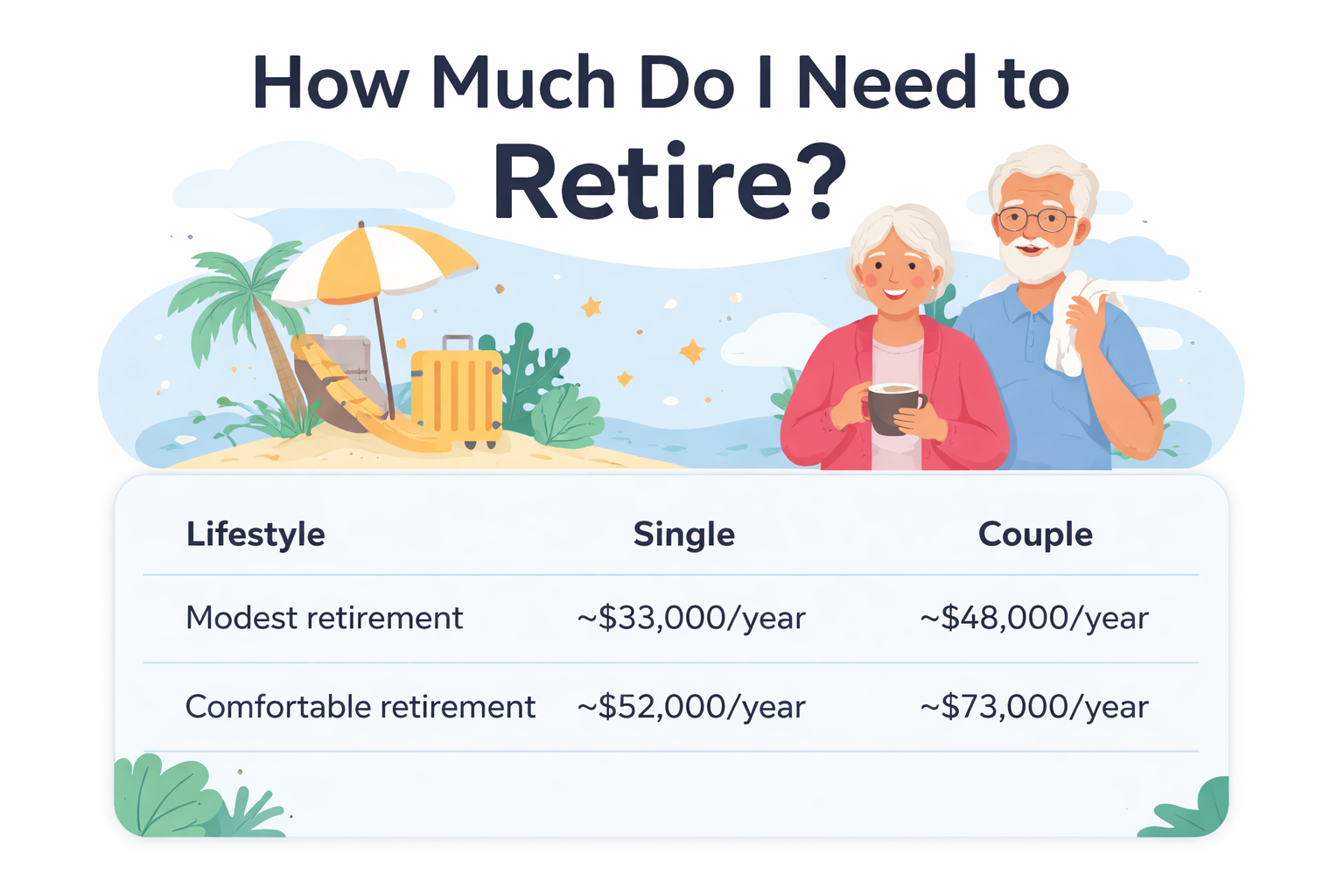
A useful Australian benchmark comes from the Association of Superannuation Funds of Australia (ASFA), which publishes annual Retirement Standard figures. As of 2026, the approximate figures for a comfortable retirement are:
A modest retirement covers basic needs with some extras. A comfortable retirement means good quality food, a car, private health insurance, occasional travel, and leisure activities.
Which one sounds like you? Be honest — most people want something closer to comfortable, even if modest sounds achievable on paper.
Step 2: Apply the 25x Rule
Once you know your annual retirement spending target, there's a simple formula to estimate how much you need saved:
Retirement savings needed = Annual expenses × 25
This is based on the "4% rule" — the idea that you can withdraw 4% of your savings per year in retirement without running out of money over a 25–30 year period, assuming your savings are invested and growing.
Examples:
These numbers can feel enormous — but remember, this is the total across all your assets, including superannuation. And the Age Pension can reduce the amount you need to fund yourself.
Step 3: Factor in the Age Pension
Many Australians will be eligible for at least a partial Age Pension, which significantly reduces how much you need to fund from savings.
As of 2026, the maximum Age Pension rates (subject to income and assets tests) are approximately:
Single: ~$1,100/fortnight (~$28,600/year)
Couple: ~$1,660/fortnight (~$43,160/year)
If you're eligible for the full Age Pension, that dramatically changes your equation. A single person spending $52,000/year in retirement only needs to fund about $23,400/year from their own savings — because the pension covers the rest.
That brings their required savings from $1,300,000 down to around $585,000. A much more achievable number for many people.
The catch: eligibility depends on your assets and income. The more savings you have, the less pension you'll receive. Use our Retirement Calculator to model different scenarios and see how the pension affects your target number.
Step 4: Account for Superannuation
For most Australians, superannuation is the primary vehicle for retirement savings. Your employer is currently required to contribute 11.5% of your salary into super (rising to 12% from July 2025).
The key questions to ask about your super:
How much do you have now? Log into your super fund's online portal or check your last annual statement.
Is it in the right investment option? Many people are in a default balanced fund, which is fine — but if you're decades away from retirement, a growth or high-growth option may generate significantly better long-term returns.
Are you making extra contributions? Voluntary contributions (salary sacrifice or after-tax) can dramatically accelerate your balance, especially with the tax advantages super provides.
Do you have multiple accounts? Millions of Australians have lost super sitting in old accounts from previous employers. Check the ATO's MyGov portal to find and consolidate any lost super.
Step 5: Calculate Your Retirement Gap
Now you can put it all together:
Your retirement spending target (annual amount × 25)
Minus your projected super balance at retirement
Minus any other assets (investment property, shares, savings)
= Your retirement gap — how much more you need to save
Use our Retirement Calculator to run these numbers automatically. Enter your current age, current super balance, income, and desired retirement age — and it will show you whether you're on track, and what you'd need to save each month to close any gap.
How Age Affects Your Target
When you retire matters almost as much as how much you've saved. Retiring at 60 versus 67 makes an enormous difference because:
You have fewer working years to build your savings
Your money needs to last longer (potentially 30+ years instead of 20)
You may not be eligible for the Age Pension until age 67
Here's a rough illustration of how retirement age affects the savings needed for a comfortable single retirement of $52,000/year:
Staying in the workforce a few extra years — or even reducing to part-time before fully retiring — can make a significant difference to the total savings you need.
What If You're Behind?
If you run your numbers and realise you're not on track, don't panic. There are practical steps you can take at every age.
In your 30s: The most powerful thing time can do is compound your returns. Even small contributions now grow significantly over 30+ years. Focus on getting into a growth investment option in your super and consider making voluntary contributions, even just $50 a week.
In your 40s: This is the decade to get serious. Review your super fund's performance compared to peers. Consider salary sacrificing into super — it's one of the most tax-effective strategies available to Australians. Pay down your mortgage aggressively so you enter retirement debt-free.
In your 50s: You're in the home stretch. Maximise your concessional contributions (currently up to $30,000 per year including employer contributions). If you have a mortgage, prioritise paying it off. Consider consulting a licensed financial adviser to fine-tune your strategy.
In your 60s: Consider a transition to retirement (TTR) strategy, which allows you to access some of your super while still working. Review your asset allocation — as you approach retirement, gradually shifting toward more conservative investments can protect what you've built.
A Quick-Reference Summary
Here's the full framework in four steps:
Decide your annual retirement spending (use ASFA benchmarks as a starting point)
Multiply by 25 to get your total savings target
Subtract the Age Pension if you'll be eligible (reduces the amount you need from savings)
Compare against your projected super and other assets to find your gap
Then use our Retirement Calculator to see exactly where you stand and what you need to do to get there.
The Most Important Thing
The biggest retirement planning mistake isn't having too little saved — it's waiting too long to find out. People who know their number, even if it's confronting, can make a plan. People who avoid the question end up with no options later.
Running your numbers today takes about 5 minutes. It tells you whether you're on track, how far off you are if not, and what realistic changes could close the gap.
Use our free Retirement Calculator to get your number right now — no signup, no jargon, instant results.
Frequently Asked Questions
Is $500,000 enough to retire in Australia? For most people, $500,000 alone is not enough for a comfortable retirement — but combined with the Age Pension, it can fund a modest lifestyle. A single homeowner with $500,000 in super receiving a partial Age Pension could have an income of around $35,000–$40,000 per year, which covers basics comfortably.
Is $1 million enough to retire in Australia? For a single person who owns their home, $1 million in super is generally considered enough for a comfortable retirement, especially when combined with a partial Age Pension. For a couple or someone who doesn't own their home, it may fall short of a comfortable lifestyle.
At what age can I access my superannuation? Your preservation age — the earliest you can access super — depends on when you were born. For anyone born after 1 July 1964, the preservation age is 60. You can access it tax-free from age 60 if you've retired, or from age 65 regardless of employment status.
What if I don't own my home when I retire? Renting in retirement significantly increases your annual expenses and therefore your required savings. The Age Pension includes a rental assistance supplement for renters, but it doesn't fully offset the cost. If you're renting, add at least $15,000–$20,000 per year to your retirement spending estimate.
ClearEveryday provides free financial calculators to help everyday person understand their money. Our tools are for informational purposes only and do not constitute financial advice. Please consider speaking with a licensed financial adviser for personalised retirement planning guidance.
ClearEveryday
Free financial calculators and practical money tools for everyday decisions.
Plan your budget, manage debt, build savings, explore investing and understand your money — with simple tools and no sign-up required.
Link
© ClearEveryday 2026. All rights reserved.
About
“For informational purposes only — not financial advice.”