Free tools • Instant results • No signup
The Hidden Cost of Minimum Payments: What Credit Card Companies Don't Emphasise
Minimum payments keep your account current — but they're not designed to get you out of debt. This post breaks down what they actually cost over time, why the numbers are more confronting than most people realise, and what to do instead.
CREDIT CARD STRATEGIES
Rachel
4/23/20269 min read
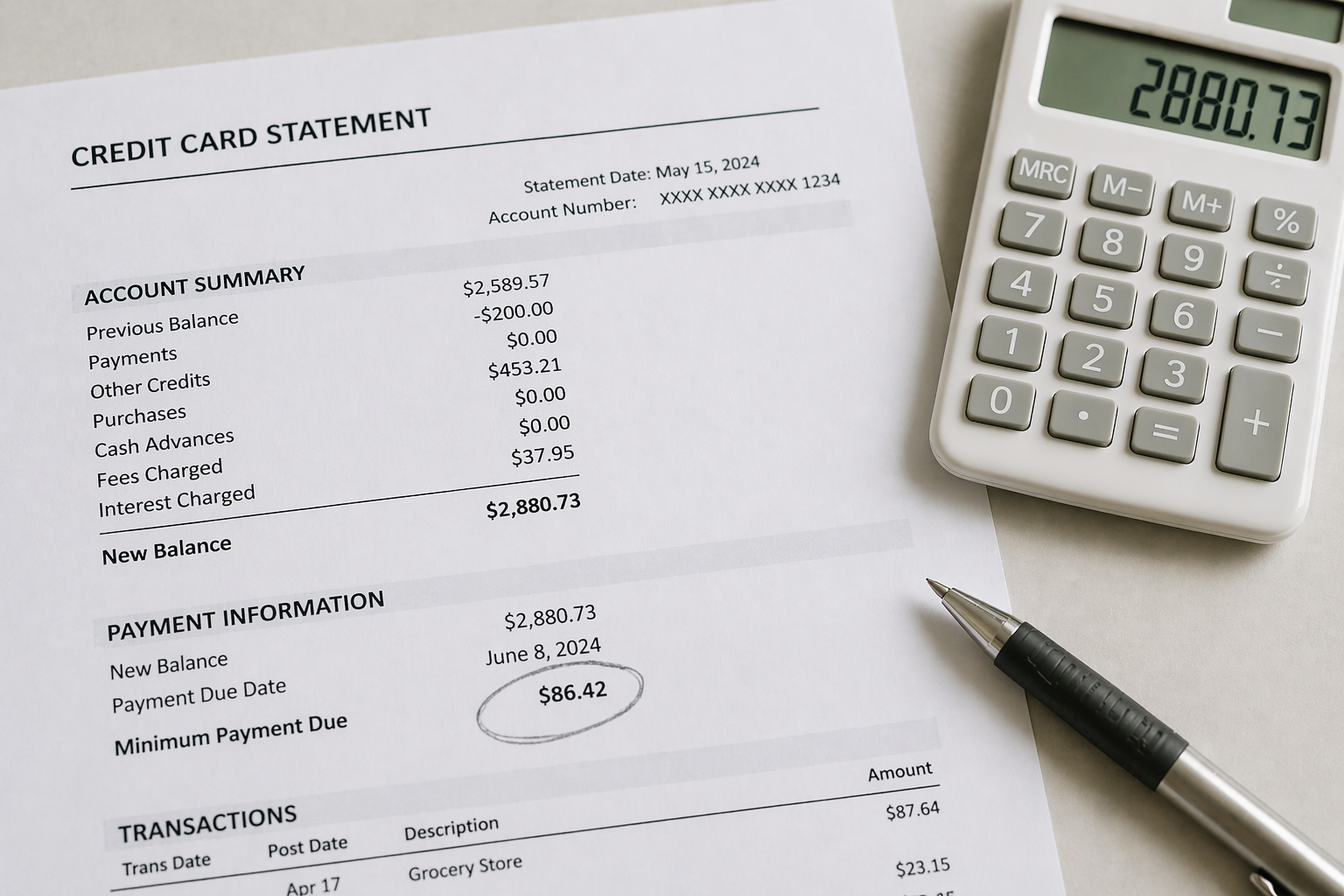
If you’ve ever opened your credit card statement and felt a bit of relief seeing the minimum payment — that small, manageable number at the bottom — you’re definitely not the only one.
In fact, that feeling is part of the design.
The minimum payment is usually low enough that it doesn’t disrupt your month too much. You can cover it without needing to rethink your spending or make any big adjustments. It gives you a sense that you’re staying on top of things, that you’re doing what you’re supposed to do.
And technically, you are. You’re keeping your account in good standing. You’re avoiding late fees. You’re maintaining your credit history.
But there’s another side to it that isn’t as obvious.
That minimum payment isn’t built to help you get out of debt quickly. It’s built to keep the account active and the balance carrying forward. On higher-interest cards, a big portion of that payment often goes toward interest first, not the actual balance. So even though you’re paying every month, the amount you owe doesn’t shrink as much as you’d expect.
That’s why it can feel like you’re doing everything right, but not really getting anywhere.
Over time, this creates a kind of quiet cycle. You pay the minimum, interest gets added, the balance barely moves, and next month you’re in almost the same position again. It doesn’t feel urgent, because the payment is manageable — but it also doesn’t move you forward in a meaningful way.
And that’s not by accident.
Credit systems are designed to make repayment feel comfortable enough that you don’t feel pressure to change anything. If the minimum payment were high, people would be forced to act quickly. By keeping it low, it stretches the repayment out over a much longer period.
This isn’t about anything hidden or misleading — it’s just the way the numbers work.
Once you start looking a bit closer, it becomes clearer. If you only pay the minimum on a credit card balance, especially one with a high interest rate, it can take years to fully pay off. And during that time, you’ll often end up paying a significant amount in interest on top of the original balance.
That’s the part most people don’t realise at first.
The minimum payment makes things feel under control in the short term, but it quietly extends the timeline in the background.
And once you understand that, it changes how you see that number. It stops looking like a helpful target, and starts looking more like a baseline — the bare minimum to stay afloat, not a real strategy for getting ahead.
You don’t need to panic or overhaul everything overnight. But recognising what the minimum payment actually does is an important first step. From there, even small changes — like adding a bit extra each month — can start shifting things in your favour.
What a Minimum Payment Actually Is
Most credit card minimum payments are calculated as either a flat dollar amount — say $25 or $30 — or a small percentage of your outstanding balance, whichever is higher. Somewhere between 1% and 3% is typical, depending on the card and the lender.
On a $3,000 balance at 20% interest, that might work out to around $60–$75 a month.
Sounds fine. Until you look at how much of that is actually reducing your debt.
At 20% annual interest, you're being charged roughly $50 in interest every single month on that $3,000 balance. So if your minimum payment is $60, only about $10 of it is reducing what you owe. The other $50 is just keeping you up with the interest.
Pay the minimum faithfully every month, and your balance barely moves. The card company, meanwhile, keeps collecting.
How Long It Actually Takes
This is where it gets uncomfortable.
Take that same $3,000 balance at 20% interest. If you only ever pay the minimum each month — and the minimum adjusts down as your balance slowly shrinks — it will take you somewhere in the range of 20 to 25 years to pay it off.
Not 20 to 25 months. Years.
And over that time, you'll pay somewhere between $3,000 and $4,000 in interest alone. Meaning you'll have paid close to double the original amount borrowed — just to clear a balance that started at $3,000.
Want to see what that looks like for your own balance? The Credit Card Minimum Payment Calculator will show you exactly how long it takes and how much interest builds up if you stick to minimums.
Why the Number on Your Statement Feels So Reasonable
Credit card statements in many countries are now required to include some version of a warning — something along the lines of "if you only make the minimum payment, you will pay more interest and it will take longer to pay off your balance."
It's there. Usually in small print. Usually easy to overlook.
But the minimum payment figure itself is front and centre, easy to read, and calibrated to feel affordable. That's not an accident. A payment you can comfortably make every month is a payment you'll keep making — and a balance you'll keep carrying.
The business model of a credit card company relies on revolving balances. Customers who pay in full every month generate almost no interest revenue. Customers who carry a balance and pay the minimum are, from a pure revenue perspective, the ideal customer.
That's not a criticism of anyone who's been in that position. Most people have been at some point. It's just worth understanding the dynamic — because once you do, the minimum payment starts to look less like a helpful feature and more like a very comfortable trap.
The Real Cost Across Multiple Cards
Now multiply this across two or three cards.
It's not unusual for someone to have a couple of credit cards, each carrying a few thousand dollars at rates between 18% and 22%. If you're paying the minimum on each one every month, you might feel like you're managing things fine — all accounts current, nothing overdue.
But the interest is compounding on all of them simultaneously. Every month you carry those balances, the cost grows. And because the minimums adjust downward as balances slowly shrink, you can go years feeling like you're on top of things while the total amount you'll end up paying keeps climbing.
The Credit Card Payoff Calculator is worth using here — put in your actual balances and rates and see the full picture. Most people find it clarifying, even if it's not entirely comfortable reading.
What Happens When You Pay Just a Little More
Here's the flip side — and it's genuinely encouraging.
You don't need to make dramatic changes to see a significant difference. Increasing your monthly payment by even a modest amount can cut years off your repayment timeline and save you a substantial amount in interest.
Back to that $3,000 at 20% example. If instead of paying the minimum you committed to a fixed $150 a month, you'd clear the debt in around 24 months and pay roughly $600 in interest. Compare that to 20+ years and $3,000+ in interest on minimums — same starting balance, completely different outcome.
That's not a small difference. That's thousands of dollars and decades of your life, changed by one decision.
The Credit Card Payoff Calculator lets you plug in different monthly payment amounts and see exactly how the timeline and total interest shift. It's one of those tools where the results tend to be immediately motivating.
Interest Rates Matter More Than Most People Realise
When you're focused on the monthly payment, it's easy to stop thinking about the interest rate. But the rate is doing a lot of the heavy lifting behind the scenes.
The difference between a 15% and a 22% interest rate might not sound dramatic. But on a $5,000 balance over a few years, it can mean hundreds — sometimes thousands — of dollars in additional interest. And most credit cards sit at the higher end of that range.
If you're carrying significant credit card debt, it's worth asking whether there's a way to reduce the rate — not just manage the balance. A balance transfer to a lower-rate card, or consolidating into a personal loan at a better rate, can meaningfully change how much of your repayment actually reduces your debt versus feeds the interest.
The Debt Consolidation Calculator can help you model what that might look like — whether combining debts into a single lower-rate loan would actually save you money in your situation.
Buy Now, Pay Later — A Quick Note
It's worth briefly mentioning buy now pay later here, because it operates on a similar psychological principle.
The payment feels small. The purchase feels manageable. And because it's spread across a few instalments, the full cost of what you've spent is slightly obscured.
Unlike credit cards, many BNPL products don't charge interest — but they do charge late fees, and more importantly, they make it easier to spend more than you would otherwise. Multiple BNPL commitments running simultaneously can quietly eat into the money you'd otherwise have available for debt repayments.
It's not that BNPL is inherently problematic. It's just worth keeping an eye on how much of your monthly cash flow it's absorbing.
How to Actually Get Ahead of It
If you've been paying minimums for a while, the first step is just getting the full picture. Know what you owe, what the rates are, and what the minimum payments actually cost you over time.
From there, even small changes make a meaningful difference:
Pay a fixed amount instead of the minimum. When you pay a percentage of your balance, the payment shrinks as the balance shrinks — which drags the process out. Pick a fixed amount you can commit to each month and stick with it regardless of what the statement says the minimum is.
Target one card at a time. Whether you use the snowball or avalanche method, focusing extra repayments on one card while paying minimums on the rest is more effective than spreading a little extra across all of them.
Look at your rate, not just your balance. If you're paying 20%+ on a card, that rate is working against you every single day. Exploring a lower-rate option — even if it means a bit of admin to set up — can be one of the most impactful things you do.
Automate more than the minimum. Set up a recurring payment that's higher than the minimum so it happens automatically each month. You won't miss what you don't see, and consistency is what actually moves the needle.
The Bottom Line
Minimum payments aren’t really a strategy for getting out of debt. They’re simply the minimum required to keep your account in good standing — nothing more.
They help you avoid late fees, protect your credit history, and keep things from getting worse. But they’re not designed to move you forward in any meaningful way. If you’ve been relying on minimum payments to slowly reduce your balance, there’s a good chance the progress hasn’t been as strong as you expected.
That’s because interest is always working in the background.
Each month, a portion of your payment goes toward interest first. What’s left over is what actually reduces your balance — and depending on your rate, that leftover amount can be surprisingly small. So even though you’re paying regularly, the balance doesn’t drop much. It can feel like you’re putting in effort without seeing results.
Over time, that creates a slow cycle. You stay current, but you don’t really get ahead. And from the lender’s point of view, that’s perfectly fine. A balance that stays around longer generates more interest, which is how the system is built to work.
The important thing to understand is that this isn’t a mistake on your part — it’s just how minimum payments are structured.
The good news is, you don’t need to make huge, unrealistic changes to turn things around.
What actually makes a difference is simple: paying more than the minimum, and doing it consistently.
That extra amount doesn’t need to be massive. Even a small increase each month can start to shift how your payments are applied. More of your money goes toward reducing the balance instead of just covering interest, which means the debt starts shrinking faster.
And once that starts happening, things begin to change.
The timeline shortens. The total interest drops. Progress becomes more visible.
Over time, those small extra amounts compound in your favour. Instead of interest working against you, your payments start working for you.
That’s where the real shift happens — not from one big move, but from a steady, intentional approach.
So rather than seeing the minimum payment as the goal, it helps to think of it as the baseline. The starting point.
From there, even modest increases — applied consistently and with a clear plan — can take years off your repayment and save a significant amount in interest.
It might not feel dramatic in the moment, but over time, it adds up in a very real way.
Tools worth using:
Credit Card Minimum Payment Calculator — see exactly what minimum payments will cost you over time
Credit Card Payoff Calculator — find out how much faster you'd clear the balance by paying more
Debt Payoff Calculator — map out a full repayment plan across all your debts
Debt Consolidation Calculator — explore whether a lower interest rate could change the picture
ClearEveryday
Free financial calculators and practical money tools for everyday decisions.
Plan your budget, manage debt, build savings, explore investing and understand your money — with simple tools and no sign-up required.
Link
© ClearEveryday 2026. All rights reserved.
About
“For informational purposes only — not financial advice.”