Free tools • Instant results • No signup

How to Pay Off Debt Faster: Proven Strategies That Actually Work
Paying off debt faster doesn't require a big income or dramatic sacrifices. This guide covers practical, proven strategies — from extra repayments and budgeting to consolidation and finding extra cash — that actually work when you stick with them.
Rachel
4/23/20267 min read
Debt has a way of staying in your life longer than you ever planned for.
At first, it might not seem too bad. You make the minimum payments, keep track of due dates, and tell yourself that as long as you’re staying on top of it, things will eventually improve. But as the months go by, the balances don’t seem to change much. Or they do move, just not enough to feel encouraging. You look at what you owed six months ago, then look at it again now, and the difference feels disappointingly small.
That’s when debt starts to feel less like something you’re solving and more like something you’re simply managing.
And that can be exhausting.
Because it’s not usually a case of doing nothing. Most people in this situation are trying. They’re making payments, cutting back where they can, and doing their best to stay responsible. But when progress is slow, it can feel like all that effort is disappearing into interest charges, minimum payments, and everyday expenses before it ever makes a real dent.
After a while, that kind of slow progress starts to wear on you. It becomes frustrating not just financially, but mentally too. You can start to feel like no matter how careful you are, you’re still stuck in the same cycle — paying, catching up, trying again, and never quite getting ahead.
That’s the part that wears people down the most. Not always the amount itself, but the feeling that there’s no real momentum.
The good news is that being in that position does not mean you’re trapped.
There are ways to speed things up, and most of them are more realistic than people expect. You do not need a perfect income, a sudden windfall, or a total financial reset to start making better progress. In many cases, what helps most is not one dramatic move, but a few practical changes working together in the background.
That matters, because a lot of debt advice can sound extreme. It can make it seem like the only way forward is to completely strip your life back, cut every enjoyable expense, and live in survival mode until everything is paid off. For most people, that is not realistic, and it is usually not sustainable either.
A better approach is to look for the changes that actually make a difference without making your life miserable.
Sometimes that means paying a little more than the minimum. Sometimes it means reworking your budget so you can see where your money is really going. Sometimes it means choosing a payoff method that fits your personality, not just the maths. And sometimes it means finding ways to reduce interest so your payments work harder for you.
None of those things are flashy, but they work.
This is not really about finding clever tricks or shortcuts. It is about understanding what genuinely helps you make progress, then using those things consistently. Debt usually builds through a mix of habits, circumstances, and timing — and getting out of it often works the same way. Small improvements, made in the right places, can build more momentum than one big burst of effort that is hard to maintain.
So if things have felt slow, discouraging, or heavier than they should, that does not mean you have failed. It usually just means your current setup is not helping you move forward as quickly as it could.
And that can be changed.
The first step is to stop looking for a magic fix and start looking at the few key areas that actually affect how fast debt gets paid off. Once you understand those, the whole process starts to feel clearer and more manageable.
So let’s go through it properly, one step at a time.
Start by Knowing Exactly Where You Stand
Before anything else, you need a clear picture of your situation.
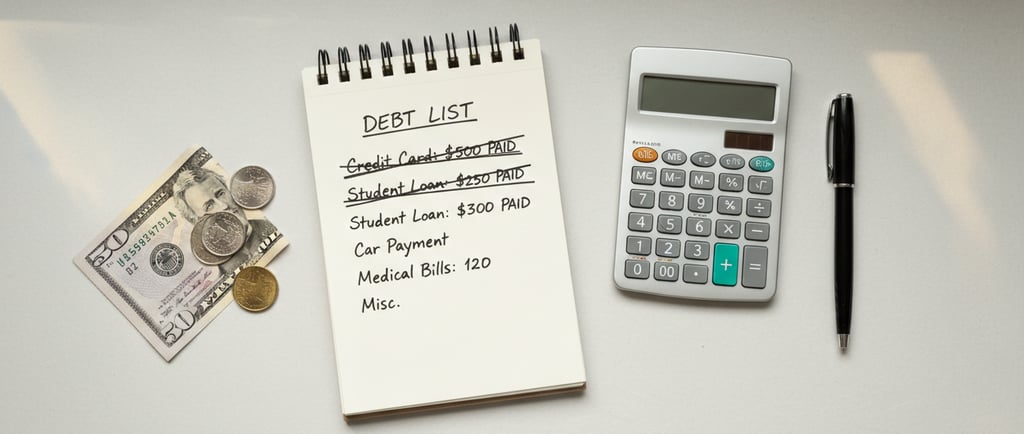
That means writing down every debt you have — credit cards, personal loans, car loans, buy now pay later, anything that requires repayment. Then list the balance, interest rate, and minimum payment for each one.
Most people think they know their debts, but it’s usually just a rough idea. And that gap between “rough idea” and “exact numbers” matters more than you’d expect.
When you see everything laid out in one place, one of two things usually happens. Either it feels more manageable than you thought, or it finally clicks why progress has been so slow.
Either way, clarity puts you in control.
Pay More Than the Minimum (Even If It’s Small)
Minimum payments are designed to keep you in debt longer. That’s just how they work.
They keep your account in good standing, but on high-interest debt — especially credit cards — they often barely touch the actual balance. Most of what you’re paying goes toward interest.
That’s why even a small extra amount can make a big difference.
You don’t need to double your payments. Even an extra $50 or $100 a month, applied consistently, can shorten your timeline more than you’d expect.
The key isn’t the size — it’s the consistency.
A steady extra amount every month beats occasional big payments. Think of it as building a habit, not relying on bursts of motivation.
Choose a Strategy — and Stay With It
Once you’re paying more than the minimum, the next step is deciding where that extra money goes.
That’s where most people come across two approaches:
The snowball method, where you pay off the smallest balance first
The avalanche method, where you target the highest interest rate first
The snowball gives you quick wins. You start clearing debts sooner, which keeps you motivated.
The avalanche saves you more money overall. You reduce interest faster, which makes it more efficient.
Neither one is wrong.
The best method isn’t the one that looks perfect on paper — it’s the one you’ll actually stick with for months (or even years).
Build a Budget That Actually Works for You
A lot of people try to pay off debt without really understanding where their money is going each month.
And that usually means they’re leaving extra repayment money hidden in everyday spending.
A budget doesn’t need to be complicated. At its core, it’s just:
What’s coming in
What’s going out
What’s left over
That leftover amount is what you can use to attack your debt.
And more often than not, once you actually look at it properly, there’s more flexibility than you thought.
The goal isn’t to cut out everything enjoyable. It’s to be intentional — to know where your money is going instead of wondering where it went.
Look for Ways to Increase What You Can Pay
Your budget shows what you have right now — but it’s also worth asking if you can increase that, even temporarily.
A few simple ways people do this:
Selling things they don’t use anymore
Picking up a bit of extra income on the side
Using bonuses or tax returns toward debt
None of these need to be permanent.
Even short-term effort can create long-term progress. A few hundred dollars here and there can knock out chunks of debt faster than you expect.
Reduce Your Interest Where Possible
Sometimes the fastest way forward isn’t paying more — it’s paying less interest.
If your rates are high, especially on credit cards, it’s worth exploring options like:
Balance transfers
Debt consolidation
Lowering your interest rate means more of your payment actually goes toward the balance, not just the charges.
It also makes your strategy — snowball or avalanche — work more effectively.
Just keep in mind: this only works if you don’t add new debt on top.
Automate Your Payments
One of the simplest things you can do — and one of the most effective — is automation.
When everything is manual, it’s easy to delay or forget. Life gets busy, and payments slip.
But when it’s automatic, it just happens.
Set your payments (even slightly above the minimum) to come out as soon as you get paid. That way, the money is gone before you have a chance to spend it elsewhere.
It removes the need for willpower — and that’s a big win.
Keep Track of Your Progress
Debt payoff takes time, and it’s easy to lose motivation if you’re only focused on the end goal.
That’s why tracking progress matters.
Even checking your balances once a month and seeing them go down can make a difference. It reminds you that what you’re doing is working.
Progress might feel slow at first — but it builds.
And once it starts building, it gets easier to stay consistent.
Expect Setbacks (and Keep Going Anyway)
At some point, something will come up.
An unexpected expense. A tight month. A missed payment.
That’s normal.
What matters isn’t avoiding setbacks completely — it’s not letting one bad moment turn into a full reset.
One slip doesn’t undo your progress. Just get back on track the next month and keep going.
Consistency over time matters far more than being perfect.
The Bottom Line
There's no single move that instantly clears your debt.
And honestly, anyone who tells you otherwise is probably trying to sell you something.
What actually works is simpler than that — and less exciting. It's a handful of small, consistent actions done together over time. None of them are complicated on their own. But when you stack them, the effect compounds.
Paying more than the minimum, even by a modest amount, means your balance shrinks faster than the interest can build back up. Sticking to a clear strategy — whether that's snowball, avalanche, or a mix of both — means your extra money always has somewhere to go instead of getting absorbed into everyday spending. Understanding your spending means you stop wondering where your money went and start deciding where it goes. Reducing your interest rate, where you can, means more of every payment actually reduces your debt instead of just servicing it. And automating where possible means progress happens in the background, without relying on willpower every single month.
None of it requires a perfect month. None of it requires a high income or a complete lifestyle overhaul. It just requires a plan — and enough consistency to let it work.
The hardest part is the beginning.
When balances are high and payments feel small, it's easy to wonder if any of it is making a difference. It is. It's just slow at first, the way most worthwhile things are. The numbers are moving even when it doesn't feel like it.
Then something shifts.
A debt drops off. A balance crosses a threshold. A minimum payment frees up and gets rolled into the next one. Suddenly there's real momentum — and the process that felt like a slog starts to feel like something you're actually winning.
That's the point most people don't reach, not because they couldn't, but because they stopped just before it.
You don't need to do everything at once. Pick one thing from this guide — the most relevant, the most doable, the one that fits where you are right now — and start there. Get that running. Then layer in the next one.
Small steps, taken consistently, get you further than big plans that never quite get off the ground.
Start today. Even if it's small. Especially if it's small.
Tools to help you get started:
Debt Payoff Calculator — see how quickly you could clear your debts with different repayment amounts
Debt Consolidation Calculator — find out if combining your debts could lower your costs
Budget Planner — map out your income and expenses to find extra repayment room
Credit Card Payoff Calculator — if credit cards are your main focus
Expense Tracker — keep tabs on spending while you pay things down
ClearEveryday
Free financial calculators and practical money tools for everyday decisions.
Plan your budget, manage debt, build savings, explore investing and understand your money — with simple tools and no sign-up required.
Link
© ClearEveryday 2026. All rights reserved.
About
“For informational purposes only — not financial advice.”