Free tools • Instant results • No signup

Debt Snowball vs Avalanche: Which One Actually Saves More Money?
Debt snowball or avalanche — which strategy pays off debt faster and saves more money? We break down both methods with real numbers, a side-by-side comparison, and help you decide which one is right for your situation.
DEBT-FREE GUIDES
Rachel
4/23/20266 min read
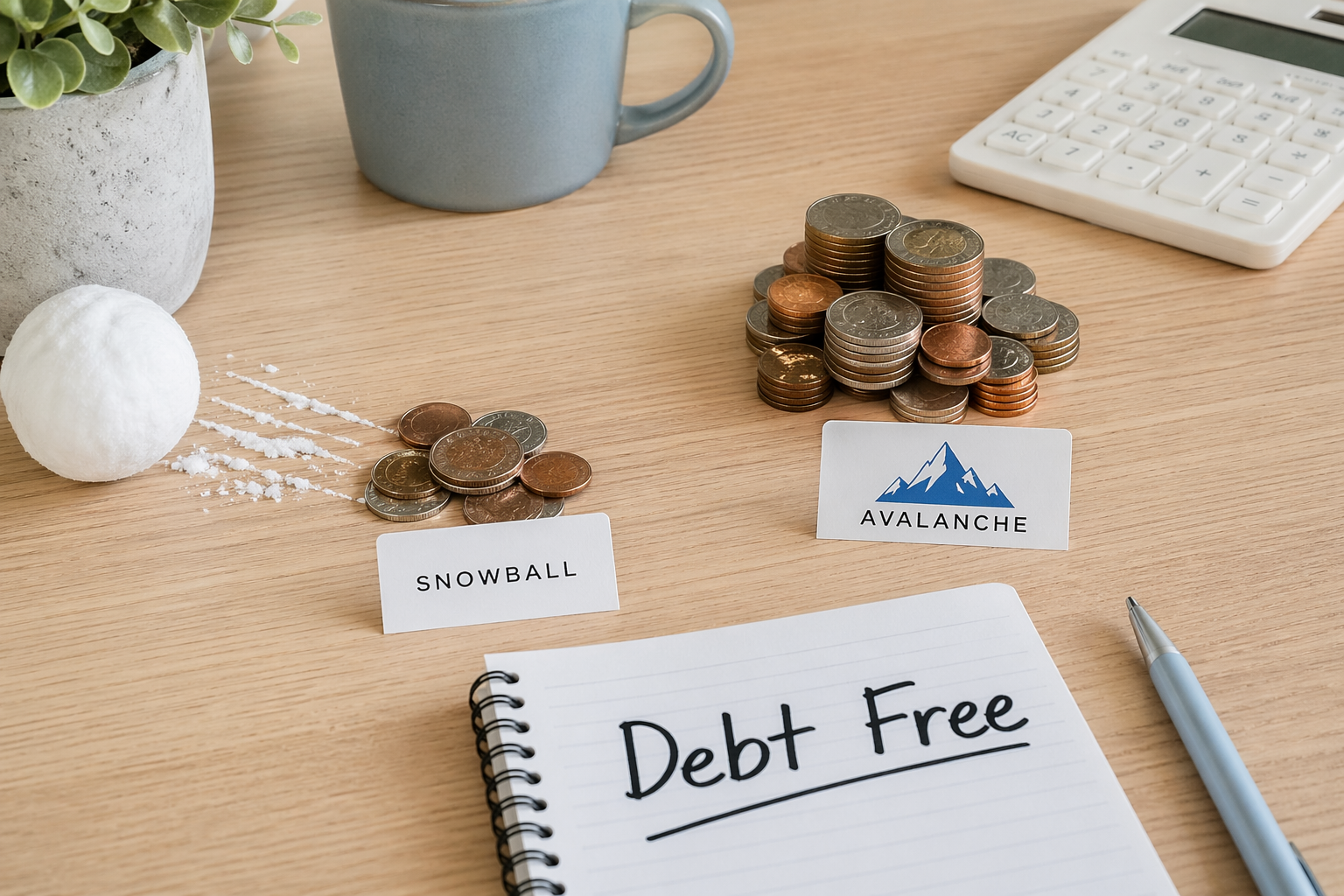
If you’ve got a few different debts hanging over your head — maybe a couple of credit cards, a personal loan, even a car loan — it can start to feel messy pretty quickly. Different balances, different due dates, different interest rates… it’s a lot to keep track of.
At some point, most people start looking for a clearer way to deal with it all. That’s usually when you come across two well-known approaches: the debt snowball and the debt avalanche.
At first glance, they sound almost identical. In both cases, you keep up with the minimum payments on all your debts so nothing falls behind. Then, any extra money you have goes toward one specific debt at a time. Once that’s paid off, you move on to the next, and repeat the process.
Simple in theory — and it is. But the part that often gets overlooked is which debt you choose to focus on first.
That one decision can change quite a bit. It affects how much interest you’ll end up paying overall, how quickly your balances start to shrink, and just as importantly, how motivated you feel along the way.
Some people prefer to see quick results and build momentum early. Others are more focused on saving as much money as possible over the long run. Neither approach is wrong — but they do lead to slightly different outcomes.
And that’s really what this comes down to. It’s not just about picking a method that works on paper — it’s about choosing one that fits how you think, how you manage money, and how likely you are to stay consistent with it over time.
So instead of just comparing them at a surface level, it’s worth breaking each one down properly — how they work, what they’re good at, and where they can fall short — so you can make a decision that actually works for you in the real world.
The Quick Version
The avalanche method usually saves you more money
The snowball method helps you stay motivated
The difference can be small… or thousands of dollars
The “best” method is the one you’ll actually follow through
How the Snowball Method Works
With the snowball method, you start by paying off your smallest debt first, no matter the interest rate.
Once that’s gone, you roll that payment into the next smallest debt, and so on.
It’s called a “snowball” because your payments grow as you go.
Why people like it:
You get quick wins early
You reduce the number of debts faster
It feels good seeing accounts disappear
The downside:
You’ll usually pay more in interest overall because you’re not targeting the expensive debts first.
How the Avalanche Method Works
The avalanche method flips the logic.
Instead of looking at balances, you go after the highest interest rate first.
Once that’s cleared, you move to the next highest rate.
Why this works:
You minimise how much interest you pay
You get out of debt slightly faster
It’s the most efficient approach mathematically
The catch:
If your highest-interest debt is large, it might take a while before you feel any progress.
A Simple Example
Let’s say you’ve got three debts and about $500 a month to put toward them:
Credit Card A: $2,500 at 22%
Personal Loan: $6,000 at 14%
Credit Card B: $1,200 at 18%
After minimum payments, you’ve got around $280 extra to work with.
Snowball order: $1,200 → $2,500 → $6,000
Avalanche order: 22% → 18% → 14%
What happens?
Snowball: ~26 months, about $1,920 in interest
Avalanche: ~25 months, about $1,640 in interest
So the avalanche saves you roughly $280 and gets you done a bit sooner.
Not life-changing — but still meaningful.
When the Gap Gets Bigger
The bigger your debts (especially high-interest ones), the more the avalanche pulls ahead.
For example, with around $40,000 in mixed debt:
Snowball could cost you about $10,800 in interest
Avalanche could bring that down to about $8,300
That’s a $2,500 difference — just from changing the order you pay things off.
So Why Do So Many People Use Snowball?
Because when it comes to money, it’s not just about numbers — it’s about how people actually behave over time.
On paper, the “best” strategy is the one that saves the most in interest. But in real life, that only works if you stick with it long enough to see it through. And that’s where things get tricky.
Paying off a small debt early might not look impressive mathematically, but it creates a real sense of progress. You close an account, you free up a payment, and you can actually see that something is working. That feeling matters more than most people expect. It builds confidence, and it makes the whole process feel doable instead of overwhelming.
Compare that to spending months focusing on one large, high-interest debt. Even if you’re doing everything right, the balance might barely seem to move at first. It can feel like you’re putting in effort without getting anywhere. That’s usually the point where motivation starts to dip — and once that happens, it’s easy to lose consistency.
A strategy that’s “perfect” on paper doesn’t mean much if you end up abandoning it halfway through. In reality, the best approach is the one you can keep going with, month after month.
That’s why the snowball method works so well for a lot of people. It keeps things moving. You’re not just chipping away — you’re actually clearing debts, one by one. And once you start seeing that progress, it becomes a lot easier to stay committed and keep going until everything is paid off.
How to Choose What’s Right for You
Go with snowball if:
You’ve struggled with sticking to plans before
You want quick wins to stay motivated
Your debts are similar in size anyway
Go with avalanche if:
You’re focused on saving the most money
You’ve got high-interest credit card debt
You can stay consistent even without quick wins
You Don’t Have to Pick Just One
A lot of people mix both.
For example:
Start with snowball to clear 1–2 small debts
Then switch to avalanche once you’ve built momentum
That way you get both motivation and efficiency.
One More Thing to Think About
If your interest rates are on the higher side — especially with credit cards — it’s worth at least considering consolidation before you lock into a payoff strategy.
What that means in simple terms is combining a few debts into one new loan with a lower interest rate. Instead of juggling multiple payments (each with their own rates), you’re dealing with just one — ideally cheaper — repayment.
The main benefit is pretty straightforward: less interest building up over time. Even a small drop in your rate can make a noticeable difference, especially if your balances are large or spread across a few accounts.
It can also make things feel more manageable. One payment, one due date, less mental load. That alone can help people stay more consistent.
That said, consolidation isn’t a magic fix. It only really works if you avoid adding new debt afterward — otherwise you can end up right back where you started, just with an extra loan on top.
But if used properly, it can give you a cleaner starting point and make whichever strategy you choose — snowball or avalanche — a lot more effective.
The Bottom Line
The avalanche method will usually come out ahead when it comes to saving money. By focusing on the highest interest rates first, you’re cutting down the amount of extra charges building up in the background. Over time, that can add up to hundreds — sometimes even thousands — saved.
On the other hand, the snowball method tends to work better for a different reason. It gives you quick wins. Paying off a smaller balance early might not save the most money, but it gives you a sense of progress. And when you feel like you’re actually getting somewhere, it’s a lot easier to stay committed.
At the end of the day, both methods do the same thing: they move you closer to being debt-free. The real difference isn’t just about numbers — it’s about behaviour. A “perfect” strategy won’t help if you lose motivation halfway through.
What really costs people is not choosing a method at all, or jumping between strategies every few months. That stop-start approach usually leads to paying more interest and feeling stuck.
It’s much better to pick one approach, set it up properly, and stick with it. If you can, automate your payments so you’re not relying on willpower every month. Then just focus on staying consistent.
It might not feel fast at the beginning, but progress builds over time. And once things start falling away one by one, it gets easier.
Keep going — that’s what actually makes the difference.
Ready to take the next step?
These tools can help you put a plan together:
Debt Payoff Calculator — map out your snowball or avalanche plan with your actual numbers
Credit Card Payoff Calculator — ideal if credit cards are your main focus
Debt Consolidation Calculator — see if combining your debts could lower your costs before you start
This article is for informational purposes only and does not constitute financial advice.
ClearEveryday
Free financial calculators and practical money tools for everyday decisions.
Plan your budget, manage debt, build savings, explore investing and understand your money — with simple tools and no sign-up required.
Link
© ClearEveryday 2026. All rights reserved.
About
“For informational purposes only — not financial advice.”